Background
This national government department was created through the merger of two departments. This integration created a complex organisational environment with multiple operational structures, cultures, and legacy practices.
The department’s mandate required an agile, collaborative, and forward-looking culture capable of responding to global shifts, environmental complexity, and the pressures of regulatory transformation. Against this backdrop, the client recognised the strategic importance of building a cohesive, values-driven culture aligned with its strategy. The merger context offered both a challenge and a rare opportunity: to shape a future-oriented culture that unifies staff and supports high performance across both head office and regional structures.
Client’s Challenge
The organisational transformation arising from the merger posed significant risks to staff cohesion, leadership alignment, and organisational clarity. The merger took place just before the COVID-19 lockdown, with the result that minimal change management support for the merger process. These challenges were compounded by structural fragmentation and differing legacy cultures across the former departments. A new integrated culture needed to support:
- Improved organisational performance
- A unified sense of purpose and behavioural norms
- Agility and responsiveness to the evolving external environment
The client required a tailored, data-driven approach to assess the current culture, engage staff meaningfully, and build a culture roadmap to guide long-term change.
Laetoli’s Role and Approach
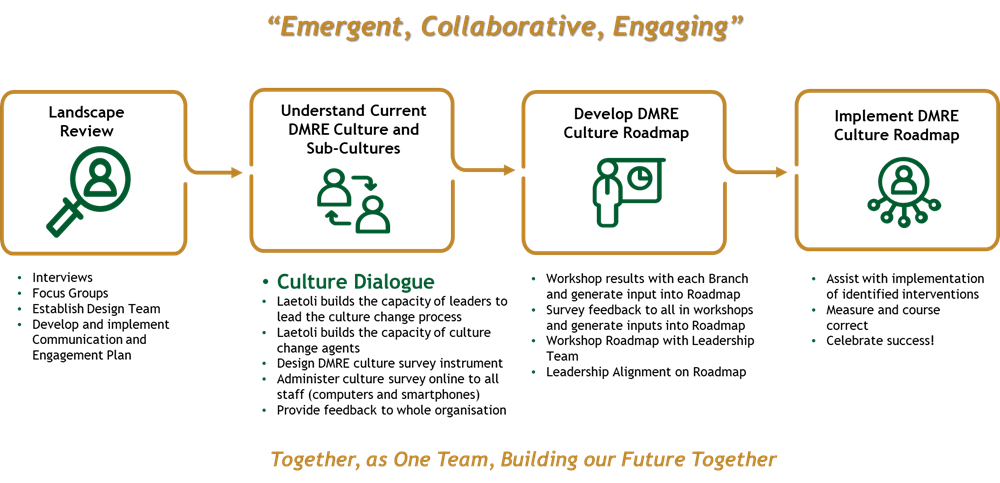
Laetoli was appointed to design and implement a participative, inclusive, and scientifically grounded culture transformation process. The approach combined diagnostic insight, co-creation, and strategic change facilitation. It included the following key components:
- Interviews and focus groups: Laetoli conducted interviews and focus groups in all regions and all branches to inform the design and content of the culture survey. Laetoli, however, realised that the level of cynicism, resistance and lack of motivation resulting from how the merger process was managed was so pronounced that it was easy to predict the outcome of a culture survey. Proceeding with a culture survey as initially planned would have been a wasted opportunity for the client.
- Leadership Engagement: Laetoli proposed to the client that they start to address these challenges by bringing as many officials as possible together, face-to-face, to start to normalise the process and to create ownership in the culture change journey. The client’s Leadership was receptive to course-correcting the project plan and agreed to a large-scale culture dialogue.
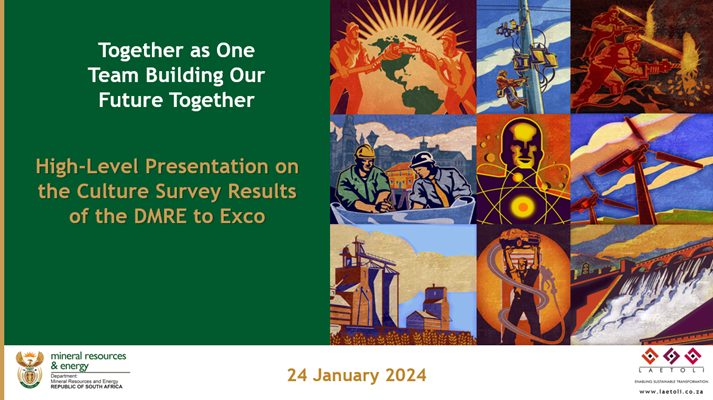
- Engagement and Dialogue: A large-scale Culture Dialogue was designed to bring together nearly 1,000 client employees, face-to-face and virtually. This was the first in-person post-merger engagement of such scale. The objectives were to:
-
- Engage staff on their lived experience of the current client culture
- Share leadership’s strategic intent and commitment to culture transformation
- Foster collaboration across historical organisational boundaries
- Generate visible support for the journey ahead
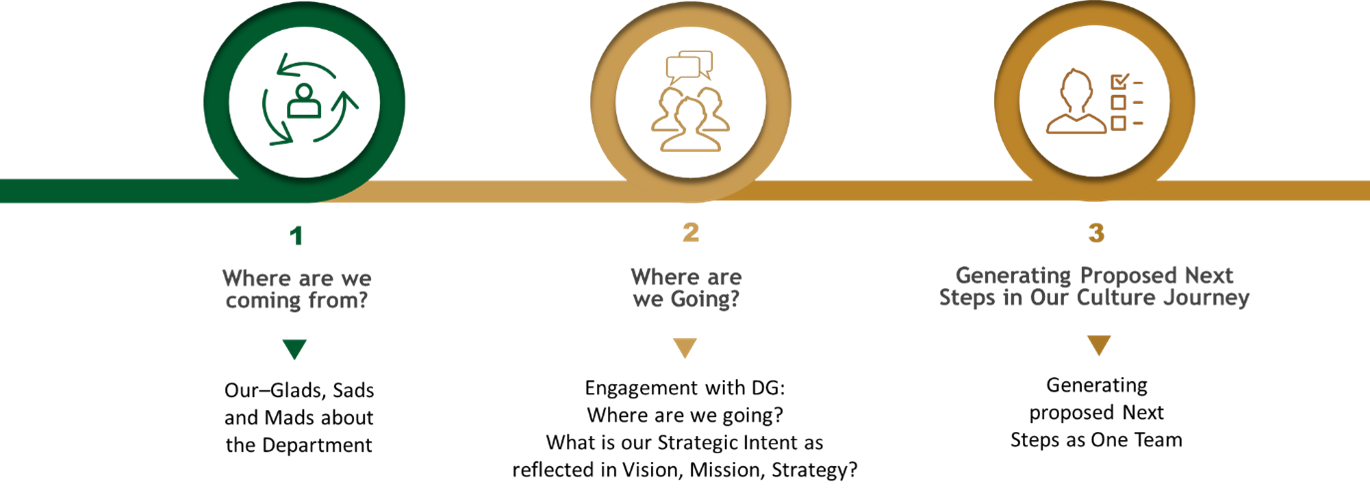
The event produced a series of “Glads, Sads, and Mads” that captured employee sentiment and informed future planning. A follow-up culture survey showed that employees who attended the Dialogue expressed more positive perceptions in the subsequent Culture Survey, reinforcing the value of engagement. During the Culture Dialogue, several recommendations were made by officials to enhance the culture integration process. The client’s Leadership acted on this, and soon after, the Culture Dialogue started to implement some of the recommendations.
- Bespoke Culture Survey Instrument: Based on Edgar Schein’s definition of culture and the Burke-Litwin Model of Organisational Effectiveness, Laetoli developed a customised Culture Survey. Key steps included:
-
- Desktop analysis of the client’s strategic and operational documents
- One-on-one interviews with the Director-General and Deputy Director-Generals
- Focus groups with regional and head office employees
- Co-design of the survey with the client Project Team and Change Agents
- Testing and refinement to ensure statistical validity and reliability
The survey was administered nationally across branches and chief directorates, generating high-quality diagnostic data.
- Dimensions Measured: The survey included 13 dimensions reflecting cultural enablers and barriers within a merged organisation:
- Strategic Positioning
- Leadership
- Values
- Ethical and Unethical Culture
- Supervisory Leadership
- Voice Behaviour
- Employee Engagement
- Decision Making
- Head Office–Region Relationships
- Employee Wellness
- Bullying
- Impact of the Merger
Each dimension included statistically validated items linked to performance, change readiness, and engagement.
- Feedback and Co-creation of Roadmap:
-
- Tailored feedback was provided to each Branch and Leadership Forum
- A one-day culture workshop was held with each Branch to co-develop their change plan
- Actionable change interventions were documented in a comprehensive Culture Change Roadmap
- Interventions Prior to Survey Rollout: Several key interventions were implemented based on Dialogue outputs:
-
- Organisation-wide feedback on Dialogue results and proposed actions
- Development and approval of an action plan by Corporate Services and Exco
- Change Management Training for Managers
- Establishment of a Change Agent Network
- Communication Strategy and Plan developed and rolled out
Outcomes and Impact
“The place felt like death—now I feel I can breathe again.”
(Employee Comment after the Large-Scale Event)
- A validated cultural baseline was established for the merged department
- Branch- and directorate-specific insights enabled decentralised action planning
- Engagement through the Culture Dialogue generated trust and commitment
- Interventions based on Dialogue inputs demonstrated a measurable shift in employee perceptions among those who participated
- The project created a foundation for embedding a values-based, high-performance culture within a complex, national public sector entity
Key Learnings
- In large-scale public mergers, active engagement before diagnosis builds trust and improves survey reliability
- Using a co-designed, department-specific instrument improves cultural relevance and response quality
- High-impact participative events (e.g., the Culture Dialogue) foster early momentum and highlight leadership commitment
- Linking cultural data to change roadmaps at both macro and micro levels ensures greater ownership and accountability