What was the business challenge?
Faced with the challenge of providing the revenue to address the legacies of Apartheid and of ensuring South Africa can compete in the global economy SARS faced an enormous challenge. Externally, the culture of evading and avoiding the payment of taxes has historically been prevalent. This fuelled the challenge of changing mind-sets and perceptions of tax and taxpayer obligations. Internally, SARS has been a product of many years of neglect and of isolation. The post-apartheid government of South Africa inherited a tax organisation that was inwardly focused, inefficient, technologically backward and equipped with outdated systems and business processes. From a people perspective SARS was also staffed and structured in an inappropriate way to meet the challenges of being a world class, innovative revenue and customs agency. Skills development was non-existent. The management culture was bureaucratic and autocratic.
The first challenge was to rethink what a world-class revenue and customs agency would and should look like, to ensure that the long term vision, mission and strategic intent focused the organisation in the correct direction. Thereafter the challenge would be that the organisation was able to fundamentally transform itself to deliver on the promises inherent in its new strategy. This would mean transforming SARS from a Present State of bureaucracy, inefficient processes, an inward focus, outdated systems and an inappropriate skills profile to a Future State of flexibility, effectiveness, technology enablement, high service orientation and the rights skills set.
Overview of the scope of Laetoli’s involvement
SARS embarked on several change and transformation initiatives designed to engage the SARS community in a critical re-evaluation of itself and to change the old SARS ‘way of doing business. It was also necessary to bring about the creation of a new sense of pride, a belief in and a sense of ownership in the new organisation.
A large-scale interactive change process was used to design the engagement process and content. With Laetoli guiding, partnering and facilitating the process with SARS, the executive committee and their direct reports – about 100 managers – first met to build a common picture of the SARS strategic intent and preferred future. The leadership community debated the nature of change and the challenge of leading transformational change in an organisation as complex as SARS.
In order to further spearhead and inform this process a National Management forum was then held to align the 500 most senior managers in SARS around its future strategy and strategic imperatives, and organisation around the strategic challenges, the intended strategic intent and the preferred future.
Following the National Forum, Regional Management forums were held involving a further 2000 SARS managers. By the end of this process, leadership in SARS was clearly aligned around a common preferred future as well as the challenges and actions required to make it a reality.
These events represented a fundamental shift in the way of doing things in SARS. In the past decisions about our strategy and transformation would have simply been communicated to the broader leadership and people in the organisation. These events allowed the broader leadership team to work with the executive committee in co-creating and defining the future strategy and way forward in SARS.
These events were of great importance to the leadership team in SARS. The leadership team worked together to build a new future for their organisation and it ended off with much pride, excitement and commitment for the future.
In early 2001, having restructured the organisation from a hierarchy to one that used teams as the foundation of its structure, Laetoli were commissioned to develop a modular team leader training designed to equip team leaders for life in the new SARS world of work – a team based structure. After months of research and development involving the consultants, internal specialists and the people who would form the future team leader and member community – the ‘Leading High Performance Teams’ training was launched and required making the transition from supervisor to team leader and manager. The challenge for SARS was to engage the new leadership community in a fundamental re-appraisal of its future, to build a collective image of potential for teams and teaming and to allow the new leadership community to plan and implement the changes required for a successful future.
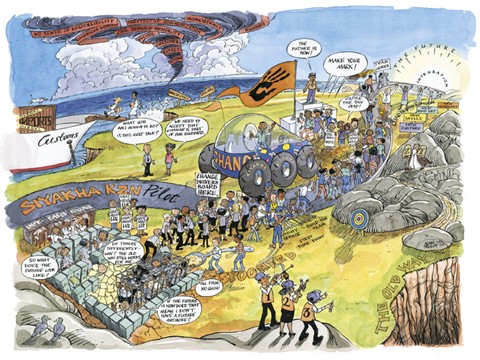
Following on from the leadership alignment process, SARS in 2003 embarked upon an organisational alignment process, engaging all of its 130000 staff in a series of workshops under the theme: ‘The Future is Now! Make you Mark!’ During these workshops, employees’ personal change journeys, their dissatisfaction with the current reality, the implications of the SARS higher purpose, the organisation’s revised strategic intent, and new strategy map were all discussed, debated and a clear picture of a common preferred future was created. During the workshop, tools to equip employees to deal with the realities of transformational change were also shared as were ways to implement the required modifications agreed upon.
As in all large-scale events and trainings, a participative training technique using a range of experiential exercises, videos, group discussions, case studies, and role-plays is utilised. In this way participants engage deeply by examining their own beliefs and exploring their connection to the broader organisational system. Laetoli believe that fundamental and sustainable change does not occur without examining and understanding one’s mindset. The forums were also fun; involving dancing, singing, and a sense of the SARS community began to emerge. Over three months, all 13000 employees were engaged in the process of designing and building their future, while at the same time, sharing their fears, frustrations and hopes. The workshops were a success in informing all employees about the intended changes; and developing action plans to ensure commitment and readiness
How did we address the business challenge?
Design Teams: The design of the content of the training interventions were guided by project/design teams. These design teams was a representative microcosm of the organisation – ensuring that all voices in the organisation could be heard and involved in planning the change effort. The design team consisted of people from all parts of the SARS system affected by Siyakha. This included employees from different levels, top to bottom, different divisions and areas as well as representatives of different stakeholder groupings such as trade unions.
The design teams planned and managed the content and process for the events by developing the agenda for the events. They also assisted in the logistics and facilitation demands ensuring the process was invisible so that the participants could focus on the content of the event.
This design team were also responsible for advising on further downstream interventions required to support and enable the Siyakha process. Being involved in the process from beginning to end would also allow for an effective transfer of skills to members of the SARS community who would thereafter understand the process of involving employees and engaging them actively in the process of change. This would facilitate the development of a change resilient culture within SARS.
- Pre and Post assessment
- A pre-intervention assessment aimed at establishing a baseline and providing insight to establish the design of the team leader modules
- A post intervention version designed to assess the impact that the process, and the ongoing operations, have on employee knowledge, skills and behaviour
- The Team Leader Training:
The modular team leader framework incorporated and blended the most successful elements of both large-scale change methodology with the knowledge, skills, tools and insight to inform the capacity of team leader’s to make successful individual and collective decisions. The six two-day modules were spread over a number of months to enable the practice and application of skills and knowledge back at the workplace. Each module built upon and further deepened the knowledge and skills learnt in the previous module and began with the opportunity to share and discuss the insights, the challenges and learning’s from the workplace application. In addition, a comprehensive toolbox was developed and provided for all participants as a support and reference resource.
How did we ensure the transfer of skills/capability building on this project?
The commitment to the transfer of skills is an integral part of the Laetoli consulting approach. Transferring skills to internal SARS resources enabled SARS to own its change processes going forward thereby ensuring sustainability.
Skills transfer happened in a number of important ways. Firstly skills transfer occurred through the effective usage of the design team, as detailed previously.
Secondly, the skills transfer happened through the usage of an HRD team who were involved in the debate over content design and creation.
Thirdly, the skills transfer occurred through an intensive Train the Trainer process where the essentials of facilitation, the importance of using interactive change processes, as well as the content and design of alignment workshops were shared and skills developed. To build internal capacity and demonstrate tangible commitment, HRD and members of the SARS training and development division also co-facilitated workshops to visibly show strong grassroots support and commitment and allow for integration of planning.
Finally, the process of the workshops themselves is empowering and a learning experience for participants. This enables the workplace use and development of dialogue as a way of engaging peers and subordinates in any process of change.
What steps did Laetoli take to ensure sustainability?
The process at SARS provided employees and leaders with an opportunity to co-create and define their future. It was a process in which all the voices of the people were heard. Together, they started to build their future – a future that they were all proud and excited about.
What were the successes of the project?
SARS has continued to extensively use large-scale change methodology to inform its change processes. In implementing change, Isivivane or design teams representing a microcosm of the community impacted upon by the changes are put together and they contribute to the planning of alignment and implementation.
The results have been impressive. At the time, SARS has exceeded its collections target of R268.5 billion by R13.1 billion. The change intervention resulted in significant gains in efficiency and productivity